Jasper Nationwide Park has virtually 4 occasions the roadkill in comparison with Banff. Here is why

Table of Contents
Neighbouring nationwide parks Banff and Jasper are very related – each are mountainous, UNESCO World Heritage websites with a significant freeway.
But they differ drastically on the subject of roadkill.
Between 2011 and 2021, Parks Canada reported 1,007 animals, coyote-sized and bigger, have been killed on roads in Jasper Nationwide Park.
That features 425 white-tailed deer, 161 elk and 125 bighorn sheep which have been killed on roads within the nationwide park.
The overall is sort of 4 occasions the quantity in Banff, the place 272 animals have been killed, regardless that that park has extra kilometres of freeway.
“It is a lot larger than we wish to see,” mentioned David Argument, a useful resource conservation officer with Jasper Nationwide Park.
A lot of the deaths are brought on by business vehicles, he mentioned.
Jasper has the next mortality price as a result of the principle freeway by the park is just not twinned, fenced or geared up with wildlife overpasses, not like its neighbour, Argument mentioned.
And it isn’t simply on highways the place animals are dying.
Over the previous decade, greater than 600 animals have died on the railway in each nationwide parks, in response to Parks Canada. The tracks usually are not fenced and there aren’t any wildlife overpasses.
Banff’s success story
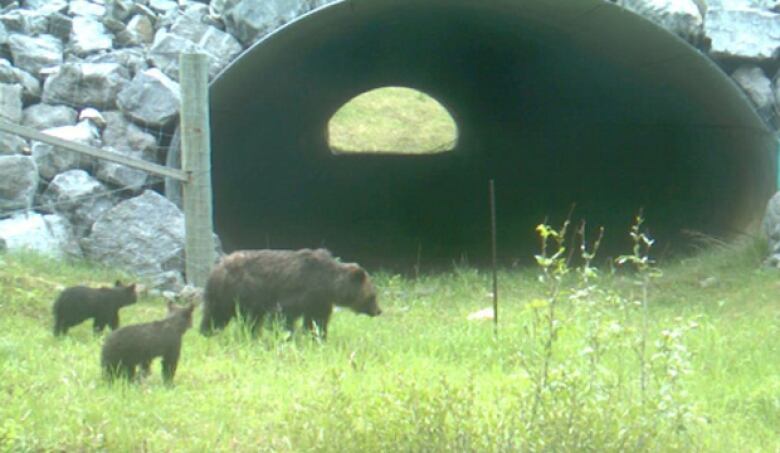
In response to the excessive variety of animal deaths in Banff Nationwide Park, work to twin Freeway 1 started within the Nineteen Eighties. By 2014, the fenced highway had 38 wildlife underpasses and 6 overpasses.
These strikes diminished car collisions with wildlife within the park by greater than 80 per cent, in response to Parks Canada.
Many biologists contemplate Banff a conservation success story.
“Every time somebody desires to implement wildlife crossing infrastructure some place else on the planet, they usually come to Banff to be taught,” mentioned Adam Linnard, Alberta program supervisor for Yellowstone to Yukon, a non-profit conservation group.
Why the identical constructions usually are not in Jasper Nationwide Park is partly as a consequence of geology, mentioned Argument.
Freeway 1 by Banff is essentially straight. By comparability, Freeway 16 in Jasper meanders. It snakes beside rivers and lakes, slithering beneath a number of cliffs.
For instance, when driving from Edmonton to Jasper, Catastrophe Level is the primary rocky level the place the freeway will get pinched between rocky bluffs and the Athabasca River. The location is common with bighorn sheep because it permits them to flee predation, mentioned Argument.
“We’ve got a good bit of sheep mortality occurring at that web site,” he mentioned.
On account of terrain, constructing an overpass can be tough and dividing the freeway virtually unimaginable.
“We must be cautious in regards to the placement of these items to guarantee that they’re in a spot the place the wildlife we’re attempting to assist can really use them,” Argument mentioned.
7:22Summer time visitors within the mountains poses a threat to wildlife
It is summer time and meaning extra highway journeys to the mountains. However additional automobiles on the highways may also pose a higher risk to wildlife. Edmonton AM’s Liam Harrap in contrast wildlife deaths on roads for Jasper Nationwide Park and Banff Nationwide Park, two of the busiest nationwide parks in Canada.
The difficulty with roads
Animals are drawn to roads for a lot of causes.
Ditches are nice for dandelions, which bears like to eat, mentioned Seth Cherry, conservation supervisor for Banff Nationwide Park.
Lately bears within the park have realized to climb the fences alongside the freeway to get the nutrient-rich flower.
“We’re taking a look at methods to refine the design of the fencing, put in perhaps an electrical wire in sure places,” mentioned Cherry.
As well as, salt added to roads in winter to make them satisfactory acts as an attractant to wildlife.
“Roads are a significant part of the human impression on earth’s ecosystems,” mentioned Adam Ford, a biologist at UBC Okanagan.
Highways additionally slice by animal ranges.
In a single research, Ford discovered chipmunks hardly ever cross roads.
“There isn’t a forest cover. The bottom is completely different,” he mentioned.
“It would not matter on visitors.”
‘One thing must be performed’
Chris Smith, parks co-ordinator for the northern chapter of Canadian Parks and Wilderness Society, a non-profit devoted to conservation, mentioned Jasper must do extra extra to scale back wildlife mortality on roads.
If Jasper maintains the established order, Smith mentioned, wildlife inhabitants numbers may very well be in danger.
For the time being, Parks Canada mentioned roadkill in Jasper is just not inflicting general decline.
“It is an unlucky supply of loss, actually, and we do not need to see them struck,” mentioned Argument.
Wildlife mortality on roads may very well be diminished dramatically, he mentioned, by individuals driving alertly and slower, giving wildlife a number of house.

Since 2011, no caribou have been killed on Jasper roads. Three grizzly bears have died. Grizzlies are listed as threatened in Alberta whereas caribou are listed as a species in danger.
Earlier this summer time a cub was orphaned after its mom was killed by a truck.
A 2016 Parks Canada report estimated as much as 10 per cent of elk in Jasper die on roads and rails.
“We would like wildlife to freely roam in our nationwide park. That is why they exist,” mentioned Smith.
“One thing must be performed in Jasper … that is unacceptable.”
There’s additionally the human value from roadkill.
In 2020, there have been greater than 35,000 collisions on Canada’s roads between automobiles and wildlife, injuring virtually 2,000 individuals and killing 17, in response to Transport Canada.
Jasper’s future
Fencing, twinning and including wildlife overpasses in Jasper would considerably lower roadkill, mentioned Argument.
However he has issues.
He mentioned fencing alone is not an answer as animals must cross roads to search out meals and mate, making overpasses and underpasses vital.
One other concern is that predators may use fences to herd prey, however in a followup electronic mail with Banff Nationwide Park, Parks Canada mentioned it had no examples of that taking place.
Linnard mentioned lowering wildlife mortality in our nationwide parks, must be a precedence.
“We form of have the next expectation of Parks Canada than we do wherever else,” he mentioned.
“We all know they’ll do it.”